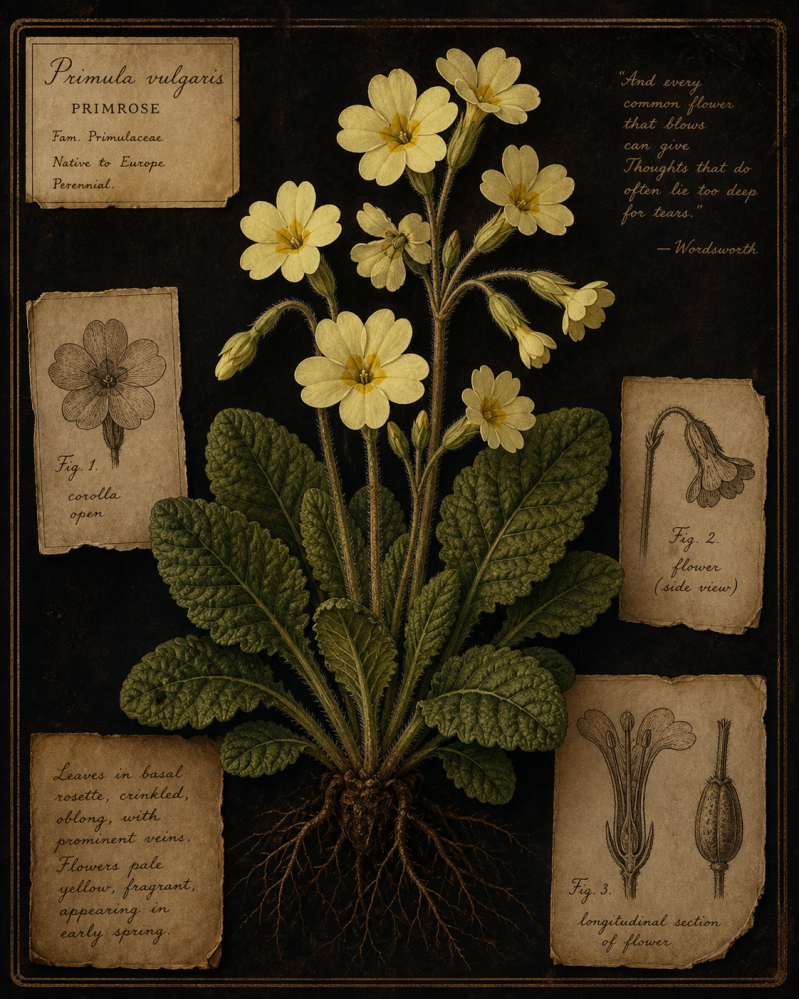
In the quieter margins of old herbal texts—those foxed, whispering volumes that smell faintly of dust and honey—you will often find the modest yet persistent presence of the Primula vulgaris. The common primrose does not demand attention; it earns it, petal by pale petal, emerging in early spring like a soft-spoken scholar returning to a long-abandoned study.
Its virtues are similarly understated, though no less profound.
The flowers, delicate and faintly honeyed in scent, have long been gathered for their gentle sedative qualities. Infusions made from the blossoms were once taken to ease the restless mind, to soften insomnia, and to quiet the low hum of anxiety that so often accompanies long winters of both season and spirit. One might imagine a candlelit desk, a porcelain cup steaming quietly beside annotated margins, the primrose working its subtle alchemy upon the nervous system.
Beneath the soil, however, the plant harbors a more assertive character. The root of Primula vulgaris has been traditionally employed as an expectorant. Decoctions were used to loosen stubborn phlegm, making it a companion in the treatment of coughs, bronchitis, and other respiratory ailments. There is something almost poetic in this: a flower of early spring assisting the lungs in their own quiet thaw.
The leaves, often overlooked, carry mild anti-inflammatory properties and have been used in poultices for bruises and minor wounds. Applied to the skin, they offer a kind of botanical reassurance—cool, calming, and quietly restorative.
In older European traditions, primrose was also associated with relief from headaches and neuralgia. Whether through direct application or infusion, it was thought to soothe the tension that coils behind the eyes and temples, that peculiar ache born of too much thought and too little rest. A plant for thinkers, perhaps. Or for those who have thought too long.
Yet caution lingers in the margins of these old texts. The root, potent as it is, can irritate if misused, and the plant’s compounds are not universally gentle. Like many remedies drawn from the earth, primrose asks for respect as much as admiration.
So it persists in the apothecary’s quiet repertoire—not flamboyant, not miraculous, but steadfast. A remedy suited to dim libraries, rain-streaked windows, and the slow, deliberate art of healing.
Active Compounds
Primula vulgaris is rich in bioactive compounds that support its traditional applications:
- Saponins (primulin, primulasaponin): These compounds exhibit mild surfactant properties, aiding in the loosening of bronchial mucus and promoting expectoration.
- Flavonoids (quercetin, kaempferol): Known for their antioxidant and anti-inflammatory effects, flavonoids may reduce airway inflammation and support skin repair.
- Phenolic acids (caffeic acid, chlorogenic acid): These acids bolster antimicrobial defenses, potentially helping to ward off mild respiratory infections.
- Essential oils (trace limonene, alpha-pinene): These oils offer gentle antimicrobial and aromatic properties, contributing to the relaxation of mucous membranes.
Research indicates that saponins interact with mucin glycoproteins, reducing sputum viscosity. Flavonoids inhibit pro-inflammatory mediators, such as TNF-α and IL-6.
Safety, Contraindications, and Side Effects
While generally well-tolerated, Primula vulgaris can cause:
- Mild gastrointestinal discomfort or nausea if taken on an empty stomach.
- Allergic reactions in those sensitive to Primulaceae family members (itching, rash).
- Rare headache or dizziness at high extract doses.
Contraindications:
- Pregnancy & breast-feeding: insufficient safety data, better to avoid or consult professional.
- Autoimmune disorders: theoretical immune-modulating effects—get medical advice.
- Concomitant expectorant drugs: may enhance mucus clearance excessively—monitor under care.
If you have liver or kidney impairment, start with the lowest practical dose and watch for subtle side effects. Always inform your doctor about herbal supplements to avoid interactions, especially with immunomodulators or blood thinners
Dosage, Forms, and Administration Methods
Here’s how Primula vulgaris is commonly utilized:
- Herbal Tea: Steep 2–3 g of dried flowers in 200 ml of hot water for 10 minutes. Consume 2–3 times daily for relief from coughs or mild skin conditions.
- Tincture/Extract: Use a 1:5 hydro-alcoholic extract, taking 20–30 drops (approximately 1 ml) diluted in water, twice a day. This is ideal for targeted respiratory or anti-inflammatory support.
- Ointments & Balms: Infuse flowers in sesame or coconut oil at a 1:4 ratio for 2 weeks, then strain and mix with beeswax. Apply to dry patches or mild eczema twice daily.
For children over 5, reduce the tea dosage by half; it is not recommended for infants without professional guidance. Pregnant or breastfeeding women should avoid high-dose extracts due to insufficient data. Always conduct a patch test before topical application to check for any sensitivities.
Culinary Uses
Young Leaves: These can be enjoyed raw or cooked, and are a delightful addition to soups. They have a mild flavor, though their texture may be somewhat tough. You'll often find these leaves available throughout the winter months.
Flowers: Both raw and cooked, the flowers serve as an attractive garnish for salads and can also be incorporated as a cooked vegetable or used in conserves. When picked at their peak bloom, the flowers can be fermented with water and sugar to create a delightful and mildly intoxicating wine. Additionally, both the flowers and leaves can be transformed into a syrup or brewed into a tea.
In Folklore
There are flowers that decorate a season, and there are those that seem to negotiate with it. The Primula vulgaris belongs to the latter category—its pale, luminous faces appearing not merely as heralds of spring, but as quiet signatures of something older, something watching from just beyond the hedgerow.
In the shadowed corridors of Celtic folklore, the primrose is entangled with the Sidhe—the unseen gentry whose favor is as delicate as it is dangerous. The flower is no simple ornament. It is, depending on the hand that gathers it, either a ward or a key. It is said that the Primrose is sacred to the Sidhe, and one must always ask their permission before it's picked.
On the eve of Beltane, when the veil is said to loosen its careful stitching, primroses were laid across thresholds and windowsills like soft-spoken incantations. Doorways framed in yellow blossoms became quiet fortresses, intended to discourage wandering fae from pilfering milk, butter, or the more unfortunate prize of livestock. Barns, too, were dressed in their fragile armor, as though petals could persuade the unseen to pass by.
And yet, the same flower that bars the way may also open it.
To gather primroses in abundance—too many, some whispered—was to risk turning protection into passage. A great handful might act as a botanical skeleton key, slipping the bearer sideways into the otherworld, where time loosens and logic frays. One imagines a scholar straying from a footpath, arms full of blooms, only to find the forest subtly rearranged, the air altered, as if reality itself had been annotated by another hand.
In the Scottish telling, the primrose offers an even more intimate trespass: to eat one is to see what is not meant for ordinary sight. A single flower, consumed, becomes a lens through which the hidden populace reveals itself—briefly, perhaps reluctantly.
Symbolically, the primrose maintains a gentler reputation. It speaks of youth, of first affections, of the tender architecture of new beginnings. Yet even here, there is an undercurrent of watchfulness. Spring, after all, is not merely renewal—it is awakening, and not everything that wakes does so kindly.
There are also prohibitions, etched like warnings in the margins of tradition. The roots of the Primula vulgaris were often left undisturbed, as though they threaded deeper than soil alone—tangled, perhaps, in the unseen territories of the Sidhe themselves. To pull them free was to risk more than botanical damage; it was to tug at something that might tug back.
So the primrose lingers at the edge of things: threshold and invitation, charm and cipher. A small flower, certainly—but one that seems to know exactly where the doors are hidden.
Cultivating the Primrose
In the enchanting world of folklore, the Sidhe, or the fae of Irish mythology, are known for their beauty and magic. Earning their favor can bring blessings and protection, and one of the most effective ways to do this is by planting primroses. These delicate flowers, with their soft yellow petals, are not only a symbol of spring but also hold a special significance in fairy lore. It is said that primroses are favored by the Sidhe, as they often bloom in the hidden corners of the earth, where the fairies dwell. When you plant primroses in your garden or near your home, you create a welcoming space for these mystical beings. To attract the Sidhe, choose a spot that receives gentle sunlight and has rich, well-drained soil. As you plant the primroses, take a moment to whisper a wish or a greeting to the Fae. Caring for these flowers with love and respect can further enhance your connection to the fairy realm. Remember, the Sidhe appreciate sincerity and kindness, so nurturing your garden will not only beautify your surroundings but also serve as an offering to these ethereal beings. By incorporating primroses into your landscape, you invite a touch of magic into your life while honoring the traditions of old.
Starting from Seeds
Patience is required to growing Primrose from seeds, but the results can be highly rewarding. Start by sowing seeds indoors six to eight weeks before the last expected frost date. Use a seed tray filled with a moist, well-draining seed-starting mix. Lightly press the seeds into the soil surface, as they require light for germination. To retain humidity, cover the tray with a clear plastic lid and place it in a bright, cool location. Germination typically occurs within two to four weeks.
Basal Cuttings
Basal cuttings involve taking small shoots from the base of the plant during spring. To encourage root development, dip the cut ends in rooting hormone before planting them in pots filled with a moist, sterile rooting medium. Cover the pots with a plastic bag or dome to maintain humidity. Position them in an area with indirect light and wait for roots to form, which usually takes about four to six weeks.
Planting outdoors
Primroses flourish in dappled sunlight or full shade. When exposed to direct sunlight, particularly in warmer climates, its leaves and flowers can scorch. For optimal growth, consider planting it in a woodland garden, along shaded garden paths, or in a north-facing flower bed.
The Primrose thrives in soil that retains moisture without becoming waterlogged. To create the ideal planting environment, enrich the soil with ample organic matter like compost, leaf mold, or aged manure. This not only enhances drainage but also infuses the soil with vital nutrients for robust growth. The ideal soil pH for Primrose is slightly acidic to neutral, falling between 5.5 and 7.0.