The Celebration of Beltane - May, 1 2026
In the old Gaelic calendar, Beltane marked the beginning of the bright half of the year, a hinge-point where fertility, growth, and vitality were not merely hoped for, but ceremonially invited. This year Beltane will be greeted by a full moon, the first Beltane moon in 38 years.
The Celt's bonfires crowned the hills. Not for spectacle alone, but for purification and promise. Cattle were driven between twin flames to guard against illness; people leapt the embers in quiet acts of faith, as though heat itself could rewrite fate. Fire, here, was both destroyer and creator. Historically, Beltane was, for our ancestors, the most important time of year, it marked spring bursting into summer.
Across the sea and into later traditions, this ancient observance softened and reshaped itself into what we now call May Day. The bones of Beltane remained, though dressed in gentler garments: ribbons wound around maypoles, flowers crowned in hair, laughter stitched through village greens. Where Beltane’s fire roared, May Day bloomed and a May Queens were crowned. Yet both speak the same language—the irresistible insistence of life returning.
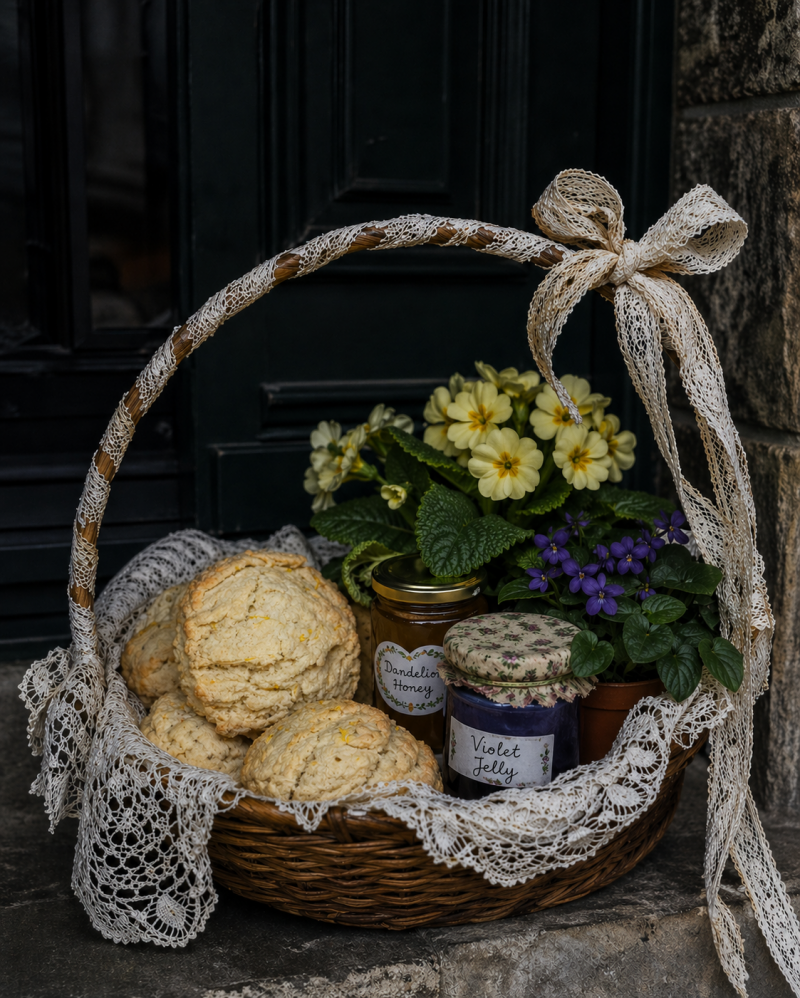
And then there is the quieter custom, almost secretive in its tenderness: the May Day basket. Small, often handmade, lined with lace or paper frills, filled with flowers or simple sweets, and left anonymously at a neighbor’s door.
This tradition, though seemingly modest, carries the echo of something much older. It is an offering without witness, a gesture unburdened by recognition. If Beltane is the bonfire blazing against the night, the May Day basket is the single candle left in a window—both acts of illumination, though one is thunder and the other a whisper.
Beltane reminds us that transformation often requires heat—that growth is not always gentle. May Day, in turn, suggests that renewal can be intimate, almost clandestine. A bloom placed quietly at a threshold may carry just as much magic as a fire seen for miles.
Together, they form a dialogue between spectacle and subtlety, between flame and flower. And somewhere in that conversation, pressed like a violet between the pages, is the enduring human desire to mark the turning of the world—not just with celebration, but with intention.
This Beltane, under the light of the full Beltane moon, we'll be leaving baskets of Dandelion scones, Dandelion honey, wild violet jelly and primroses and Johnny Jump-ups for those we want to share celebration of the season of light.

The May Queen
The May Queen represents the essence of spring—wild and untamed. Chosen to embody this vibrant season, she appears as though spring itself has taken human form, gracefully stepping into our world.
On May Day, the May Queen stands at the vibrant heart of the celebration, crowned with blossoms that are both wild and ceremonial. She serves not as a ruler but as a symbol: the living embodiment of renewal, fertility, and the fleeting, intoxicating victory of life over the long austerity of winter. Where Beltane once kindled bonfires to summon abundance from the land, the May Queen becomes that abundance made manifest—walking, breathing, adorned in petals rather than flames.
Traditionally, she is a young woman, often selected for her grace and presence, yet beneath that simplicity lies something deeper and more archetypal. She resonates with figures rooted in folklore: the maiden aspect of the seasonal cycle, the living promise that the earth will bloom again. Her crown, crafted from hawthorn, daisies, or primroses, is not just decoration—it is a circlet of the land itself, a quiet coronation performed by field and hedgerow.
In many celebrations, she oversees the dances around the maypole, ribbons spiraling like threads of fate being rewoven. This dance is not mere revelry; it reflects the intertwining forces of growth, community, and continuity. At the center stands the May Queen, still and radiant, as if she were the axis upon which the season turns.
Yet there is a fleeting quality to her role, and that is part of its allure. She reigns for a day, perhaps just an afternoon. Then the crown is set aside, the flowers wither, and she returns to ordinary life. The symbolism is clear: spring is ephemeral, beauty is transient, and even the most vibrant bloom must eventually fade.
Viewed through a more contemplative lens, the May Queen takes on a mythic quality—a figure caught between worlds. She represents youth at its zenith, but also serves as a reminder of the quiet passage of time. Like a pressed flower tucked into the pages of an old book, her presence lingers long after the festival concludes, a delicate imprint of something once alive and radiant.
To honor the May Queen, then, is not merely to celebrate spring. It is to recognize the fragile brilliance of renewal itself—the way life reemerges, time and again, clothed in green and gold, urging us to notice before it inevitably slips into memory. Celebrate the season of light by fashioning a circlet of flowers to wear while planting the garden under the Beltane moon.